Wednesday, November 13, 2013

Doing Life For Non Violent Crime

I know what some of you are thinking. "There goes that PR Brown again criticizing the criminal justice system as If these people aren't guilty and don't bring it on themselves." No that's not the case. Many of the people who are incarcerated are actually guilty, and deserve to incarcerated. But when the scales of justice are so statistically unbalanced that African-Americans receive the lions share of long prison sentences for non-violent crimes, I would be remiss if I did not shed light on yet another "design flaw" in the system especially given the fact that the ranks of those who have been doomed to live out their days as state property has increased.

A new academic study of 58,000 federal criminal cases has found significant disparities in sentencing for blacks and whites arrested for the same crimes. The research led to the conclusion that African-Americans’ jail time was almost 60% longer than white sentences.

While serious crime rates in the U.S. have been declining for the last 20 years, the number of prisoners serving life sentences has more than quadrupled since 1984. As documented in a new report done by sentencingproject.org over 159,000 people were serving life sentences in 2012, with nearly 50,000 serving life without parole.

Key findings from the report include:

  • One of every nine individuals in prison is serving a life sentence.
  • The population of prisoners serving life without parole (LWOP) has risen more sharply than those with the possibility of parole: there has been a 22.2% increase in LWOP since just 2008.
  • Approximately 10,000 lifers have been convicted of nonviolent offenses.
  • Nearly half of lifers are African American and 1 in 6 are Latino. 
  • More than 10,000 life-sentenced inmates have been convicted of crimes that occurred before they turned 18 and nearly 1 in 4 of them were sentenced to LWOP.
 Here is one mans story.

Robert Booker admits that he didn't really need the money he got from drug dealing. He grew up in a two-parent, middle-class family in Detroit in the 1970s, and his job as a lifeguard for the city's parks department paid "good money." But the drug business paid more, and by the late 1980s nearly all of his friends were showing up to the pool with new cars and expensive sneakers. "I was smarter than the average cat, and I was like, 'If they could do it, I could do it easy,'" Booker said by phone on Monday from the Federal Correctional Institution in Schuylkill, Pa. "I left lifeguarding and started hanging around."

Twenty-five years later, at 47 years old, Booker is two decades deep into a life sentence in federal prison for three related, nonviolent drug crimes: possession with intent to distribute crack cocaine, conspiracy to possess with intent to distribute crack cocaine, and operating a "crack distribution house." Although a trial judge initially sentenced him to 20 years in prison, the prosecutor filed two separate appeals, ultimately triggering an automatic sentencing mechanism that forced a federal judge to send Booker to prison for the rest of his life. 

He has used his time in prison to study law and write fiction, and published a crime novel, entitled "Push," in 2006.

PR

Tuesday, November 12, 2013

Peace Or Piece

It is probably the thing that is most desirable thing in the world. Often sought after but not always found. It can mean different things to different people. But it all comes to the same conclusion. 

PEACE

You can have a million pieces, and not one of them can give you one ounce of peace. 
Let's not confuse peace with happiness. Happiness is a wonderful thing but it has it's plateaus and it's valley's depending on the moment. 
But peace is an everlasting commitment to maintaining your mind, and not allowing your circumstances to drive you out of it. Peace is living assured that your best efforts, and good works have not been and will not be in vain. Peace is knowing that no matter what slangs and arrows of outrageous misfortune seem to come your way, peace is knowing that your are safe in the hands of the father.

Having peace is not tangible. You can't touch it, hold it or see it. Pieces satisfiy our senses. But sensory satisfaction is temporary. Peace is more precious than a million pieces, and more valuable than anything that money can buy.

PR

Monday, November 11, 2013

Your Testimony!

A wise man once said. In life, you're either going into a storm, in the midst of a storm, or coming out of a storm.
The first time that I heard this it was a little difficult for me to understand. It sounded as if it meant we were doomed to live our lives in constant chaos surrounded by storms at every turn. But as I pondered the meaning in prayer and I began to evaluate my own life I began to realize that the storm analogy is representative of an ebbs and flows, and the ups an the downs that wait around every corner as long as we continue to live.

Some of us, especially those of us who are Christians, may ask ourselves why God allows certain things to happen to us. We struggle to understand devine reasoning and we wonder what we did to deserve, what feels like punishment. But what we must realize is that each and every trial that we go through, and each and every tribulation that we suffer is a building block for our testimony. The Lord allows us to go through so that he can bring us out. But he doesn't bring us out just because he can. He brings us out stronger than we were when we went in. He does this both as a testament to his glory, and because he loves us. Everything that we go through makes us stronger, as serves to inspire others who may be in their own personal storms to hold on, perservere. There is no progress without struggle, and no testimony without being tried in the fire. 
Your testimony will not only help others to continually stand in his word. But it will help you continue to stand on his word.

PR

Saturday, November 9, 2013

How A Prison Record Can Ruin Your Life


As living, breathing human beings mistakes are a part of life. I believe that each and every mistake yields a valuable lesson. We learn, and we move on. Hopefully we use those lessons and experiences to make better decisions. 
But unfortunately some mistakes make it impossible for us to move on and we are forced to suffer the consequences. Our lives can be forever changed by seconds of bad judgement, and an unforgiving criminal "justice" system designed to dole out buttonless punishment that goes far beyond prison walls. You may be of the opinion that if someone commits a crime they deserve to be at the mercy of the system. But if we are honest with ourselves, we must realize that any one of us could have been incarcerated for one reason or another, and we're all just one bad decision away from being state property. Once you're in the system your chances of actually having a second chance is practically non existant, and you will be force to pay your debt to society long after you're out of the system. This debt becomes eternal.

Luis Rivera had some peace of mind for about five months, from late fall of 2010 through early spring of the following year. That’s the closest thing he’s seen to financial stability in more than twenty years.

 “I got hired for a wonderful job. It was a clerk/porter/doorman position at a high-rise classical building in the East Village,” he recalls wistfully. Rivera, 44, has a wife of twenty-five years and three teenage daughters. They live up in East Harlem, where the Puerto Rican–born New Yorker grew up and has spent much of his life. He’s ferociously proud of his marriage and children; his back straightens and his tone turns serious when he talks about his family, like a man who’s managed to achieve something he’s been told he can’t accomplish. Yet looking back on those five months as a jack-of-all-services for wealthy downtown hipsters, Rivera still gets excited about an opportunity that tore him away from home at all hours.

“When they needed somebody, they would call me in the middle of the night and I would say, ‘Yes!’ Because I needed a job. And the pay was excellent,” he brags, pointing to his $17 hourly wage for part-time work. “I was next to be hired in a position there permanently.” 

The new position held promise that Rivera could finally work just one legit job on the books, with steady hours and a steady paycheck, rather than hustling to piece together part-time informal work, as he’s done his entire adult life. But that promise hadn’t yet been realized. He was still at the mercy of his employer’s whims. If they called, he worked; if not, he didn’t. So when the superintendent of a building across the street mentioned that his crew was looking for part-time help as well, Rivera put in his name. While applying, he was honest to a fault.

“I made the mistake of trusting,” Rivera says now, shrugging. “I explained to this guy that I have a record from 1990-something. But I explained that I paid the price. I’m clean, gimme a chance. He gave me his word of honor that he would not tell.” But word travels fast when you’re an ex-con. Suddenly, the upscale building at which Rivera hoped to build a future stopped giving him shifts at all.

“So I made a phone call and asked to speak to them,” he explains. He says his boss told him, “We found out you have a record. And you can’t work here, due to the fact that this is a fancy place anything could happen.” 

At age 22, Rivera says, he committed a burglary in the Bronx. He was a lousy criminal and soon got caught. The judge didn’t make him serve any time, just released him to his parents’ custody and gave him five years of probation. Within two years, he’d earned release from probation as well. But the conviction has nonetheless stalked him ever since. “Twenty years later, it’s still there.” 

Rivera is part of an uncounted population of formerly convicted or incarcerated people trying to find work in a hostile economy. They are failing, by and large, thanks to the illegal but still widespread practice of employers rejecting applicants or firing workers solely because they have criminal records. A growing movement is pushing states to “ban the box,” or more closely regulate when and how employers can ask about criminal records on job applications. The movement has logged some victories: in October, Target, the nation’s second-largest retailer, announced that it would stop asking the question of prospective employees. The move comes after Target’s home state of Minnesota passed “ban the box” legislation, one of ten states to do so, according to the National Employment Law Project (NELP). But the way that many companies screen for criminal records is already barred by federal law. 

Back in 1987, the Equal Employment Opportunity Commission declared that blanket bans on hiring people with criminal records were a Civil Rights Act violation. The EEOC noted that the law bars not only overt bias based on protected categories like race, but also seemingly neutral policies that have the effect of reinforcing racial disparities So it told employers that they can consider criminal records only as one factor in hiring, and then only when the conviction is directly related to the work. But Congress is most responsible for undermining this guidance. Following 9/11, lawmakers issued blanket bans on former felons working in a broad range of transportation jobs. States followed suit, and the list of banned occupations grew exponentially: private security guards, nursing home aides, just about any job involving kids. Former felons are now categorically barred from working in more than 800 occupations because of laws and licensing rules, one study estimates. 


Partly in reaction to this growing list, and partly in response to the simultaneous explosion of the background check industry, the EEOC issued an updated guidance in 2012. The new guidance didn’t change the core idea that blanket hiring bans based on criminal records have a disproportionate impact on black and Latino workers and thus violate the Civil Rights Act; instead, it offered employers updated details on how to stay on the right side of the law. In summary: if you conduct background checks, your hiring systems must include a granular method of confirming their accuracy and considering the specifics of a person’s case. The experience Rivera describes is just the sort that would not pass muster.

This summer, the EEOC showed its willingness to enforce those rules. In June, the watchdog filed separate suits against BMW and Dollar General. BMW’s subcontracted hiring firm had imposed a blanket ban that not only affected new hires but led to the firing of many longtime employees. In Dollar General’s case, one of the plaintiffs had been denied work because of a six-year-old conviction, which drew the EEOC’s scrutiny not only because the practice is illegal, but also because the woman had previously worked for a different retailer in the same type of job without incident. “That’s huge,” says Maurice Emsellem of the National Employment Law Project. “The guidance is one thing, but all this activity surrounding the guidance—that shows they’re enforcing it.”

If so, the EEOC has got its work cut out for it. There’s no firm number on the population of workers with criminal records, but the NELP estimates that there were 65 million in 2010—a stunning 28 percent of the adult population. In 2006, the Justice Department spitballed the number at 30 percent of working-age adults. A great many of these people have faced background checks. In explaining its updated guidance last year, the EEOC cited a 2010 study showing that 92 percent of large employers run background checks.

PR

Thursday, November 7, 2013

Just When You Thought You Heard It All News (11-9-2013)


There used to be a time when perverts were on the down low. They hid in the shadows with the rest of the creeps and weirdies. But these days some of them believe that they actually have the constitutional right to be creepy.

A Massachusetts man claims he has the constitutional right to take "upskirt" photos of women in public. Michael Robertson, now 31 was arrested in 2010 after trying to take cellphone photos up women's dresses on the Boston subway, 

The Andover man is charged with two counts of photographing an unsuspecting nude or partially nude person, and faces more than two years in jail if found guilty.

On Monday, Roberton's lawyer, Michelle Menken, argued before the Massachusetts Supreme Judicial Court that Robertson did not commit a crime because his right to snap photos up women's skirts is protected under the First Amendment. 

“If a clothed person reveals a body part whether it was intentional or unintentional, he or she can not expect privacy,” Menken said in court. She went on to say that "peeping Tom" laws protect people from being photographed in bathrooms or dressing rooms, but do not protect clothed individuals in public areas.

She also argued he could not be guilty of photographing a "partially nude" person because the women in the photos were fully clothed, and their genitalia was covered by underwear

“What he saw was in plain sight. He did not place his camera directly up a women’s skirt. He saw what was in front of him,” she argued.

State Attorney Cailin Campbell countered that subway passengers have an "understandable expectation" that they will not be "photographed like that in that kind of setting." 

In 2006, a 34-year-old man in Oklahoma was acquitted in a similar case when. After he stuck a camera under a 16 year old's skirt at a Super Target store and snapped a picture of her underwear, the court ruled that the teen did not have "a right to a reasonable expectation of privacy." 

However, the ruling caused such public outrage that the state eventually passed a law explicitly making it illegal to take photos of a person's private areas in public without his or her permission.

As the father of two daughters I believe that it is my constitutional right to slap the hell out of any jerk with enough balls to take an up skirt photo of one of my daughters.


I said it before & I'll say it again. Bacon makes everything better. Add bacon and cheddar cheese to anything and it's as close to paradise on a plate as you can get. But who in their right mind wants to smell like breakfast?!

From the makers of such classics as bacon condoms?!?!?! Bacon lube?!?!?! 
and bacon shaving cream?!?!?? comes Power Bacon, a deodorant with the scent of..........bacon. 

bacon deodorant
"Power Bacon deodorant is designed specifically for those with active lifestyles or people who just sweat like pigs," reads the product page on J&D Foods' website, and lucky you, the stuff is on sale for the bargain price of just $9.99. 

Wouldn't it be cheaper to just buy a pack of bacon, fry it up, and rub it under your arms. Gross, I know. But probably just as effective.


The only thing worse than losing your home, and all of your worldly possessions in a fire is getting a bill from the Fire Derpartment for putting out the fire. From the looks of the photo above they didn't do a very good job of saving the actual house. It's looks to me like they passed buckets of cold water to each other and tossed it at the house. 

An Arizona couple recently left homeless when their mobile home burned to the ground couldn't believe their eyes when they received a bill for nearly $20,000 from a private fire department.

"I couldn't believe it," Justin Purcell told the local media. "We lost our home, we just had a baby and now we're going through this. It's crazy. We don't know how we are going to come up with the money."

Justin and Kasia Purcell's home went up in flames on the night of Aug. 12. The Purcells, who were staying with relatives because they were preparing for the birth of a child, were not home at the time of the fire. A neighbor notified them of the blaze, and they made the 45-minute drive to their home in Surprise, a city in Maricopa County. 

Surprise?! I guess that explains the bill.

OThey arrived just in time to see firefighters extinguish flames from what was left of their house. The home was a total loss, and the cause of the blaze is undetermined.

Two weeks later, on Aug. 27, the couple received a bill from Rural Metro Fie Department for $19,825. The bill included charges of $1,500 per fire truck and $150 dollars per hour for firefighters.

Justin Purcell said he was shocked by the bill and did not understand why he was receiving it, considering he and other local residents pay a fire district assistance tax to help fund volunteer fire departments. However, that tax, he soon learned, does not cover Rural Metro Fire Department because it is an independent agency.

The Purcells' next step was to contact their insurance company.

"I was told by our insurance company that they don't cover fire departments in county areas," Justin Purcell said. "I asked our insurance [representative] what the typical city fire department charges them and he said he had never seen a bill for anything over five or six thousand dollars."

When contacted  on Monday, Colin Williams, the public information officer for Rural Metro, said the bill is justified.

"This family, like many others, elected to not pay their annual fire service bill," Williams said in an email. "Others in their area pay Rural/Metro for fire protection."

The annual subscription, according to Williams, is "roughly $290 per year." However, a subscription bill from a neighbor of the Purcells shows the fee to be $474 per year.

The Purcells claim they would have paid for the subscription had they known it existed.

"We would have paid it in a heartbeat," Kasia Purcell said. "We never received a letter from them."

Williams said the family elected not to subscribe.

"Of course they knew they had an obligation/option to pay our annual subscription. ... They, along with others across Arizona, in areas we serve, elected to ... roll the dice that they would not have a fire they lost," he said. 

Talk about cold blooded!

"We provided service to them and now they are mad. This is not new. We bill for unsubscribed fires all of the time. ... Why should these people ride the coat tails of their neighbors who elect to have a fire service contract with us?"

According to media sources, people living in the Purcells' neighborhood were clueless about the Rural Metro subscription plan until after the Purcells' fire.

"Coincidentally, we all received a bill from Rural Metro fire informing us we have no fire coverage in our area, so they highly suggested we finally begin paying some fire coverage that we didn't currently have," the Purcells' neighbor, Kelly Miller, said.

Rural Metro has acknowledged they did not market subscriptions in that area until recently.

It should also be noted that Surprise firefighters were first on the scene at the Purcells' mobile home fire. They arrived approximately 13 minutes after the fire started. Their firehouse is located about seven miles from the Purcells' home. Rural Metro, the Purcells said, did not arrive until much later. The Rural Metro firehouse is approximately 20 miles away.

"They weren't even the first responders," Justin Purcell said. "We arrived 45 minutes after the fire started, and it was pretty much extinguished by Surprise. Rural Metro showed up after we were already there. They basically did a mop-up saturated the hotspots with water."

WOW! 

Killed For Asking For Help....AGAIN!

As much as I love being Black in America I have to admitt that there are certain "hazards" that go along with this journey. I realized quite some time ago that I had to follow a different set of rules than society at large. Understanding these rules, and following them have been an integral part of becoming in man in my early forties. Things like appearing non threatening to the rest of the world, trying to differentiate yourself from negative stereo types or cooperating with Police who want to serve most of the public but won't protect you, has been a way of life for years for those of us who actually care about growing old. But unfortunately applying these rules is difficult when the very sight of you instills fear, and suspicion despite your intentions. These emotions relegate you to nothing more than a dangerous enemy, and on many occasions they can transform you into a victim.

Police are seeking charges against a Dearborn Heights, Michigan resident for shooting and killing a 19-year-old Detroit woman who sought help at the resident’s house after a car accident early Saturday morning.

The Dearborn Heights Police Department said, and autopsy information from the Wayne County Medical Examiner’s Office confirm that Renisha McBride was shot in the head with a shotgun around 630 am Saturday by a resident of a house near the scene of a car accident after attempting to seek help at the house. Her cellphone battery had died, her family said.

Police initially told McBride’s family her body was “dumped” and found near the house she approached. Police have since changed their account of events, saying McBride died on the resident’s front porch. Police added she was supposedly believed to have been an intruder and shot in self-defense.

Here we go AGAIN!

Neighbors of the shooter said they were also told by police at the scene that the shooting occurred based on self-defense.

McBride’s maternal aunt, Bernita Spinks, told The local media the young woman was shot in the back of the head as she left the porch of the home where she sought assistance.

Spinks said no matter if the shooter believed McBride to be an intruder, shooting her was not justified.

“He shot her in the head ... for what? For knocking on his door,” Spinks told the local media on Tuesday. “If he felt scared or threatened, he should have called 911.”

Dearborn Heights police have asked the Wayne County Prosecutor’s Office to file charges against the shooter. Police have not made the person’s name public.

Spinks praised the decision to seek charges, saying, “Thank you Jesus! I’m very happy there is progress (on the case).”

Yet Michigan has a “stand your ground” law, which allows people to use deadly force against “perceived”threats to protect themselves, whether or not they attempt to flee.

Spinks said McBride’s family met with the Prosecutor’s Office Tuesday. She believes the shooting was racially motivated.

“You see a young black lady on your porch and you shoot?” Spinks said.“He killed my niece and he needs to pay for it. He needs to be in jail.”

“There was no window broken. My niece didn’t bother anyone. She went looking for help and now she’s dead.”

The area where McBride was killed in Dearborn Heights, a predominately white area, is about 12 miles west of Detroit, a predominantly black city.

McBride left home Friday night in a white Ford Taurus without telling anyone where she was going. Her family was informed of her death Monday morning.

McBride’s family said she was soft spoken, hardworking and stayed to herself. She had just begun a job at Ford Motor Co.

A vigil for McBride was held on Wednesday at 4:45 pm in front of the home where she was killed.

There are many different adjectives that I could choose to describe this seemingly repeatitive narrative. Tragic, disgusting, and disturbing are just of few of the words that come to mind. But perhaps the most perplexing detail about this story is that a nineteen year old girl with her entire life ahead of her was murdered for doing nothing more than being African-American and in distress.


PR

Wednesday, November 6, 2013

6 Reason's Why You Should Tip

Working in the service industry can be a thankless job. You're on your feet all day, and you have to put up with all kinds of outrageous demands & nonsense all for minimum wage or less. Even if you've never worked in this industry it is important to remember that most of those who do, are hard working individuals trying to make a living just like you and me. Here are 6 reasons why you should reward good service with a good tip.

1. The federal minimum wage for tipped workers is only $2.13 per hour, and it’s been that way since 1991. That’s less than one third of the federal minimum wage.

2. While there are tipped workers who make good money at fancy restaurants,that’s more the exceptionthan the rule. The fact is that tipped workers are more than twice as likely as any other workers to live in poverty.

3. When you hear the phrase “living off tips,” you should take it quite literally.

For example, more than half of the average bartender’s income comes from tips, and an even higher percentage of a waiter's income comes from what you dole out.

4. You only need to make $30 a month in tips to be considered a “tipped worker.” A lot of bosses are stealing those tips.

5.  Around 90 percent of restaurant workers say they don't get paid sick days. 

6. Female tipped workers typically makeless per hour than their male peers, who tend to get the fancier jobs.

Food for thought.

PR

Tuesday, November 5, 2013

Blocking The School To Prison Pipeline

 
The school to prison pipeline was once thought to be a myth. But given the overwhelming evidence it has become difficult to relegate to to urban legend. At least a portion of it, the fact that school age children are being saddled with criminal records due to minor offenses thus ruining their futures, has been acknowledged. Many have theorized, including me, that the school to prison pipeline is nothing more than a way to supply the prison industrial complex with and endless supply of slave labor. But I digress.
Finally amid public outcry, an unlikely school district in an unlikely state has decided to do something about it.........

One of the nation's largest school districts has reached an agreement with law enforcement agencies and the NAACP to reduce the number of students being charged with crimes for minor offenses.

The agreement with Broward County Public Schools in Miami, Florida, which officials announced yesterday, is one of the first comprehensive plans bringing together district officials, police and the state attorney's office to create an alternative to the zero tolerance policies prevalent in many schools. It charges principals rather than school resource officers with being the primary decision makers in responding to student misbehavior.

The move is designed to cut down on what has become known as the "school-to-prison pipeline," where students accused of offenses like disrupting class or loitering are suspended, arrested and charged with crimes.

Broward, the nation's seventh largest district, had the highest number of school-related arrests in Florida in the 2011-2012 school year, according to state data. Seventy one percent of the 1,062 arrests made were for misdemeanor offenses.

In this South Florida district and others across the country, minority students have been disproportionately arrested, sometimes for the same offenses their white peers received only a warning for. Nationwide, over 70 percent of students involved in school-related arrests or law enforcement referrals are black or Hispanic, according to U.S. Department of Education data.

"It's pretty rare," Michael Krezmien, a professor at the University of Massachusetts Amherst, said of the agreement. "I think if every other school district did it that would be a great step forward."

The new policy creates an action plan for district officials and school resource officers to follow when a student misbehaves. For non-violent misdemeanors like trespassing, harassment, incidents related to alcohol, possession of a misdemeanor amount of marijuana and drug paraphernalia, administrators are instructed to try and resolve the situation without an arrest. A variety of alternatives, like participation in a week-long counseling program, are designed to address and correct the student's behavior.

No student would be arrested for a first non-violent misdemeanor, but further offenses will result in graduated levels of school-based interventions. After a fifth incident, students are referred to law enforcement.

Felonies or serious threats will still be handled by police.

The policy went into effect at the beginning of the current school year, and Broward Superintendent Robert Runcie said the district has already seen a 41 percent decline in the number of school-related arrests.

Runcie became superintendent two years ago, and said one of the first things he did was look at student achievement and outcomes. One of the data sets that stood out to him the most showed black male students in particular falling behind academically. When he dove further into the data, he found the same group was misrepresented in terms of expulsions and arrests.

"One other thing I heard quite a bit about was students being arrested for things that I would never have believed constituted an arrest," Runcie said. "For example, tardiness. Trespassing. Throwing spit balls. Things that you just, using a common sense approach, would say, we wouldn't want to do this to a child because once you get a record, it basically stays with you for your life."

Runcie worked with the NAACP to create a new student code of conduct. The NAACP said they had attempted to address student discipline with two previous superintendents, without any success.

"Everybody deserves a second chance and this program will do just that," said Marsha Ellison, president of the Fort Lauderdale/Broward County NAACP. "And all students will be treated equally no matter what the color of their skin."

The NAACP said they hope the policy will serve as a model for other districts nationwide.

"People are, I think, becoming more knowledgeable as they see the data and more willing and wanting to fix this problem," said Niaz Kasravi, the NAACP's criminal justice director.

Krezmien said large school districts in particular have struggled to come up with alternatives to zero-tolerance policies because they are often following state guidelines that define what a school disciplinary problem is.

"I think most of them are kind of stuck because they don't have a good model, or they don't have an infrastructure within the school to deal with what really are, most behaviors, school disruptions," Krezmien said. "It's amazing how a disruptive behavior can be deemed a threat and suddenly, it's a kid who's in court over that."

He said creating a policy and implementing it, however, are two distinct challenges, and it will be key for both administrators to receive proper training and for the role of police to be redefined.

Despite data showing the negative consequences of policies that criminalize student misbehavior, Krezmien said there has not been an overall push toward creating zero-tolerance alternatives and said the Broward agreement was unusual.

The U.S. Justice Department and the Department of Education's Office of Civil Rights have addressed the issue in individual school districts. In Missisippi, a federal judge has scheduled a December 2014 trial for a Justice Department lawsuit that claims there is a "school-to-prison pipeline" in part of the state that locks up students for minor infractions like flatulence or vulgar language.

FInally the Florida justice system will benefit someone besides George Zimmerman.

PR

Sunday, November 3, 2013

MOM FIRED, For Trayvon Costume.

As I reported in my original piece last week some ignorant kids saw fit to mock the life and death of Trayvon Martin by wearing black face, using fake blood and taking a disgusting photo to celebrate their sick costumes. 

http://theprbrownreport.blogspot.com/2013/10/the-trayvon-martin-halloween-costume.html?spref=tw

They thought that they could actually get away with it, and so did their parents. As a matter if fact so did I. But not so!

To the mom who thought  it was cool for her kids to dress up like Trayvon Martin and George Zimmerman for Halloween, I'm glad karma has come to bite you in the butt.

According to reports, Caitlin Cimeno has been fired from her job for posting racially-insensitive photos of her sons, William Filene and Greg Cimeno, with the caption: “Happy Halloween from Zimmerman & trayvon (insert smiley face emoji here.)”

The Massachusetts woman failed to realize that you can be easily tracked down if you post your full name, photos of your children at school, shots of your car with the license plate and selfies at work (stooopid!). After one Instagram user wrote, “You ruined your life by posting those pics,” Caitlin quickly changed her profile name and deleted the racist shots. But sadly for her, it was too late.

According to the Facebook page Stop Blackface For Halloween,  "Caitlin Cimeno had her employer listed on her Facebook page, but recently deleted it. Members of the Tumblr community took note of this employer before the deletion and contacted them to report the incident. Around 12:54 pm, I called the employer to report the incident and they stated that she has been fired.”

Maybe she can get a job with the KKK. Those guys love sick costumes.

PR

Friday, November 1, 2013

Just When You Thought You Heard It All News (11-2-2013)

Mom stunned by act of kindness at Pizza Hut

This story proves that you never know who's watching, and you never know who's looking. But you can can be sure that somebody always is.

A single wrote to her local news station to share a story of what happened to her family at a Pizza Hut in Durham.

The Raleigh woman said the past few years have been very trying for her family. She is going through a messy divorce, has had to move several times, and had to take a year off from attending college. She said recently she found out that her 4-year-old daughter has bullying tendencies, and her 6-year-old son is living with Asperger's and ADHD.

Every Friday night, the woman takes her family on a dinner tour where they eat at a different restaurant each week. On Friday, the family went straight from daycare and after school to the Pizza Hut off Sherron Road.

It was around 6 p.m., and her son's medication had long worn off. She was left with parenting lessons she had learned from classes and reading.

She said after they were seated, she saw a young man seated alone in a nearby booth. As she would normally do, the mother apologized for how loud the children were going to be and asked him to forgive them.

He told her not to worry because he had three children of his own and could relate.

The mother and her children went on with their meal. The woman practiced her usual engaging behavior trying to keep the kids occupied and on their best behavior.

After the young man in the adjacent booth finished his meal and left, a waitress and the manager came over to the family's table.

The waitress told the woman that the man asked for paper and a pen shortly after the family was seated. Before he left, he paid the family's bill and left them with a Pizza Hut gift card.

The woman said with tears streaming down her face, she was handed a three page letter the man had written. Now with the waitress and the mother both crying together, they started to read the note:

"I do not know your back story, but I have had the privilege of watching you parent your children for the past 30 minutes. I have to say thank you for parenting your children in such a loving manner.

I have watched you teach your children about the importance of respect, education, proper manners, communication, self control, and kindness all while being very patient. I will never cross your path again but am positive that you and your children have amazing futures.

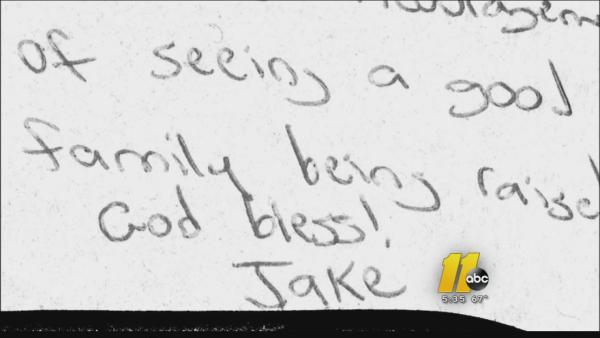
Keep up the good work and when it starts to get tough do not forget that others may be watching and will need the encouragement of seeing a good family being raised. God bless! -Jake"

SIDE BAR: Does this guy look simple, or is it just me?

There are loser's, there are low life's, and then there's Andrew Palmer.

The Baltimore man dubbed the "Dine and Dasher" by police is at it again, authorities and restaurant owners say.

Andrew Palmer, 46, notorious for racking up food and drink tabs at area restaurants, then faking seizures to get out of paying the bill, was arrested early Monday after owners said he refused to pay a $50 bill at Viccino Jay's Italian Gourmet in Baltimore, Maryland.

The night before, he went limp at upscale barbecue restaurant Oliver Speck's in Harbor East when it was time to settle up on a $90 tab, according to the owner and a patron.

"The paramedics showed up and said, 'Looks like our guy's back,'" said Oliver Speck's chef Jesse Sandlin. "He would not wake up, and they were like, 'Come on Andy, stop faking.'"

Police say Palmer, who has a career rap sheet more than 90 arrests long and has been found guilty of petty theft at least eight times in the past year, is making the rounds again.

He's being held at Central Booking in lieu of $1,500 bail. His most recent public defender did not return a message seeking comment. Court records list Palmer as homeless or at an address on South Broadway that no longer exists.

It's not that prosecutors haven't been able to win convictions against Palmer. It's that the crime, in most cases, theft under $100 doesn't carry a large enough penalty to deter someone with a taste for good food and drink who's willing to do jail time, and because it's a nonviolent offense, those who are found guilty serve only a fraction of their sentences.

Officials with the Baltimore state's attorney's office could not be reached for comment, but police accounts from recent cases tell a familiar story.

In December, police say, he had the $24.99 shrimp platter and four alcoholic beverages at the Inner Harbor's Bubba Gump Shrimp Factory. "This is an ongoing problem with Mr. Palmer in the downtown area," Officer Daniel Sexton wrote in charging documents.

In January, police say, he went large at Sullivan's Steakhouse, ordering the chicken piccata with a lobster add-on, a 22-ounce ribeye steak, four Blue Moon beers, three Bacardis and, for good measure, a coffee. It led to his second arrest of the week.

"Palmer's seizure occurred when he was confronted about his unpaid bill as he exited the restaurant," Officer Michael McGrath wrote in a statement of probable cause. McGrath added that Palmer is "well known to local restaurants and members of the Baltimore Police Department."

The unpaid tab: $160. The sentence: one year in jail.

He was out by July. That month, police say, he had three Blue Moon drafts, an espresso martini, two beers from Union Brewing Co. and three Stoli Oranges at the Admiral's Cup, good for a $72 bill, then went into the back of the Fells Point restaurant and had what appeared to be a seizure. In writing a report, the officer listed Palmer's alias as "Dine and Dasher."

Court records show the case was dropped, but he received a citation for another theft charge a few days later and got 90 days in jail.

Matt Belardi, 37, was hanging out at Oliver Speck's in Harbor East on Saturday night when he said patrons noticed the man at the bar mumbling to himself.

Sandlin said Palmer was dressed normally and was pleasant. He had ordered the pork chops, macaroni and cheese, soup and several drinks. A bartender believed he was getting too intoxicated, and Sandlin said to cut him off. She said he collected his things, then put his head down on the bar and passed out.

Belardi was skeptical. "You could tell he wasn't really passed out. He had gone from zero to blackout in the snap of a finger," Belardi said.

Sandlin called police and said the officer who arrived said the best she could do was write him a citation, and it is unclear whether one was issued. No such charge for that night appears in the state's court records database, and a police spokesman could not say late Tuesday what action, if any, the officer took.

The next night, police charged Palmer with refusing to pay at Viccino Jay's Italian Gourmet, near Penn Station.

"He was just watching the football game, eating food, and when it came time to pay, he didn't have any money," said manager Jeri Shuck, who said Palmer didn't require medical attention that night. "It's a horrible thing for someone to be doing, but for him it's a pretty good situation -- get a free meal, get locked up, get a free meal. Just a running circle."

Sandlin's frustrated that authorities can't put a stop to it.

"If this guy came up and mugged me on the street and took $90 from me, he would've gotten arrested," she said.

Unarmed robbery, when something is taken by force, carries a maximum penalty of 15 years in prison, but theft, a property crime, brings a maximum of 90 days.

"What's the difference in the end?" Sandlin asked.

Palmer has been convicted of ripping off the Capital Grille, the now-closed Burke's and Shucker's, Maisy's, and restaurants in Anne Arundel, Baltimore and St. Mary's counties.

In 2010, prosecutors beefed up the charges, combining a slew of cases into a theft scheme charge that brought a heavier maximum penalty. He was convicted and sentenced to 18 months.

When he was released last summer, police put out an alert to restaurants that Palmer was back in circulation. And over the course of seven days in late July and early August, Palmer was arrested three times.

Two of those cases included charges of making a false call requiring an ambulance response. That carries a maximum sentence of five years in prison, but prosecutors dropped the charges.

The city Fire Department said it has to respond to the 911 calls related to Palmer and eat the costs.

"We treat each patient according to the complaint, signs and symptoms," said spokesman Ian Brennan. "In the case of an uninsured individual or in rare repeat cases like this, the bill usually goes unpaid."

When customers skip out on the tab, Shuck said, it typically comes out of the server's paycheck. Belardi said Palmer is also distracting paramedics from more serious calls.

"I don't think the guy understands that he also may be tying up EMS paramedics from helping somebody who really needs it," the Oliver Speck's patron said.

In the meantime, Sandlin says, restaurateurs need to spread word about Palmer so he is easily recognized and establishments can refuse service. She has posted his mug shot on her Facebook page.

Had Palmer went to "Roscoes Chicken and Waffles" and pulled this nonsense, I'm sure that this story would have ended much differently.


After you read this story you might think that what this Elmer Fudd look a like did was a little extreme. But let this be a lesson to anyone who has the slightest inclination to do anything stupid. You never know when or how it could come back to bite you!

A man in still Springs, Tenn., is accused of shooting a teenager multiple times after he toilet-papered a school principal's yard.

Franklin County Sheriff's Office spokesman Sgt. Chris Guess said suspect Dale Bryant Farris, 65, fired at least two shots, with [shotgun] pellets striking the teenager in the right foot, inner left knee, right palm, right thigh and right side of his torso above the waistline.


The home being toilet-papered wasn't Farris'. It was the residence of Huntland School principal Ken Bishop, who declined to press charges against the teen or his friends, who were allegedly involved in the prank.

"We want everybody to have a good time, but we want everybody to be safe," Guess said. "If residents believe property is being vandalized "they need to get on the phone and call law enforcement."

According to the local media the teen who was injured, declined medical treatment. 

Farris is charged with aggravated assault and reckless endangerment.

His court date is scheduled for Dec. 5.


PR